Complex stacks
Choose layers, position, and twist to define the device you need.

01 / Research Systems
A workhorse for your lab, freeing researchers to do research rather than tedious fabrication.
Glovebox-compatible, fully automated scan and transfer, with machine-vision assembly and optical quality assurance.
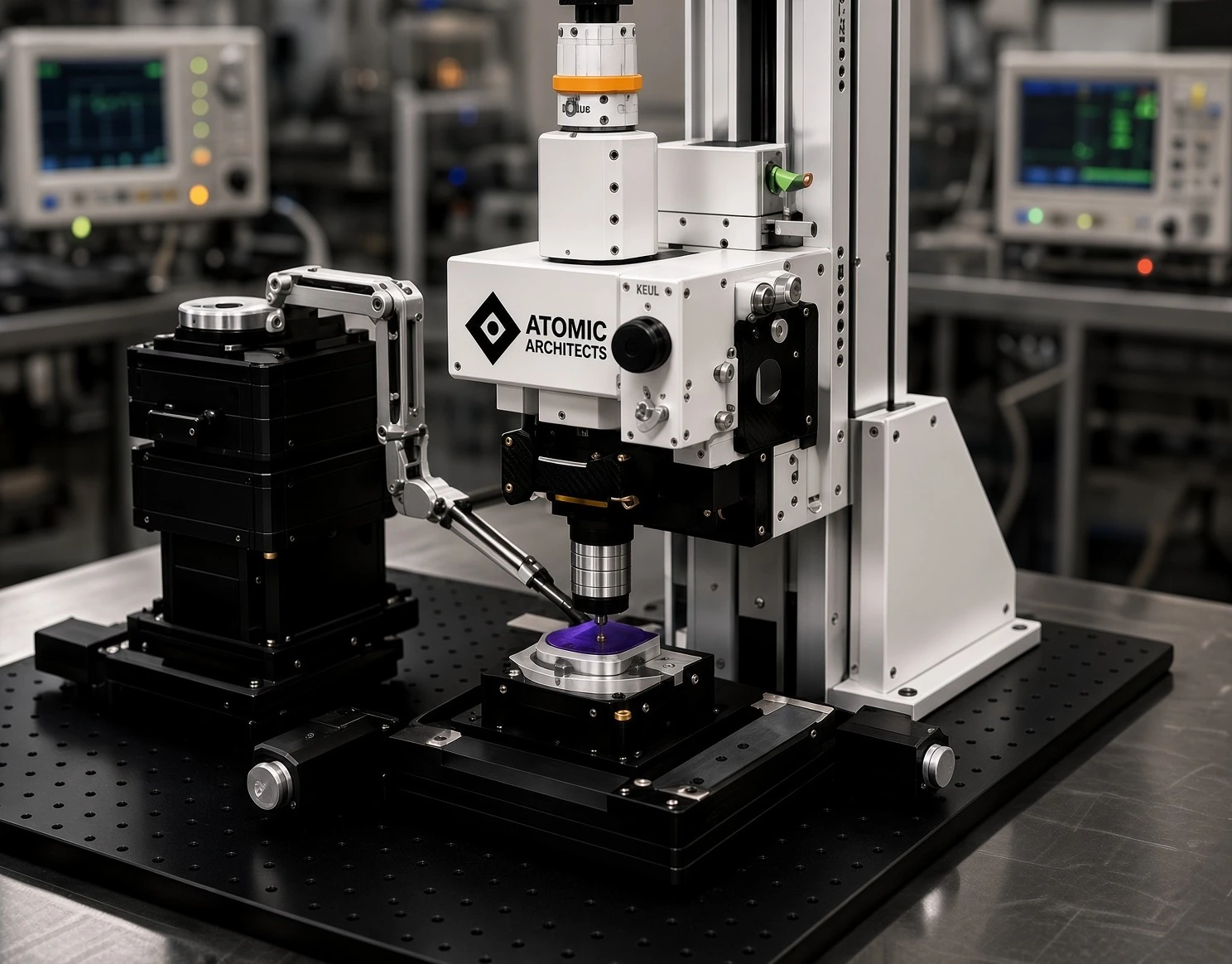
Built for demanding research
For universities, national laboratories, and industrial R&D teams developing complex 2D heterostructures.
Choose layers, position, and twist to define the device you need.
Machine-vision feedback controls assembly rather than relying on manual user manipulation.
Connect the starting crystals, assembly workflow, and optical metrology into a build record for quality assurance.
System configurations
Choose the Core System or extend the platform with confocal second harmonic generation (SHG) mapping for advanced twist control.
The foundation
Advanced twist control
All Core System capabilities, plus:
From single crystals to a complete device
Autonomously find candidate crystals and record their morphology and metadata.
Select the layers and define their relative position and twist.
Autonomous assembly under closed-loop machine-vision control.
Link optical quality assurance to the completed build.
The system seamlessly connects scanning, device design, machine-vision-driven assembly, and optical QA.
Practical questions
No. The user prepares the chips. The assembly workflow starts with the supplied material, including exfoliated flakes or CVD-prepared material.
The researcher remains in control of the device design, including final flake selection from a searchable database. Machine-vision control automates the assembly process.
Confocal SHG mapping, automatic twist-angle recognition and armchair / zigzag edge detection, alongside the Core System capabilities.
Right now: TMDs, hBN, and graphene. We will expand the material database quickly. Contact us to request a specific material.
Discuss materials, stack complexity, optical QA, and the configuration that fits your research.